Protest Paintings: Jacqueline Fahey

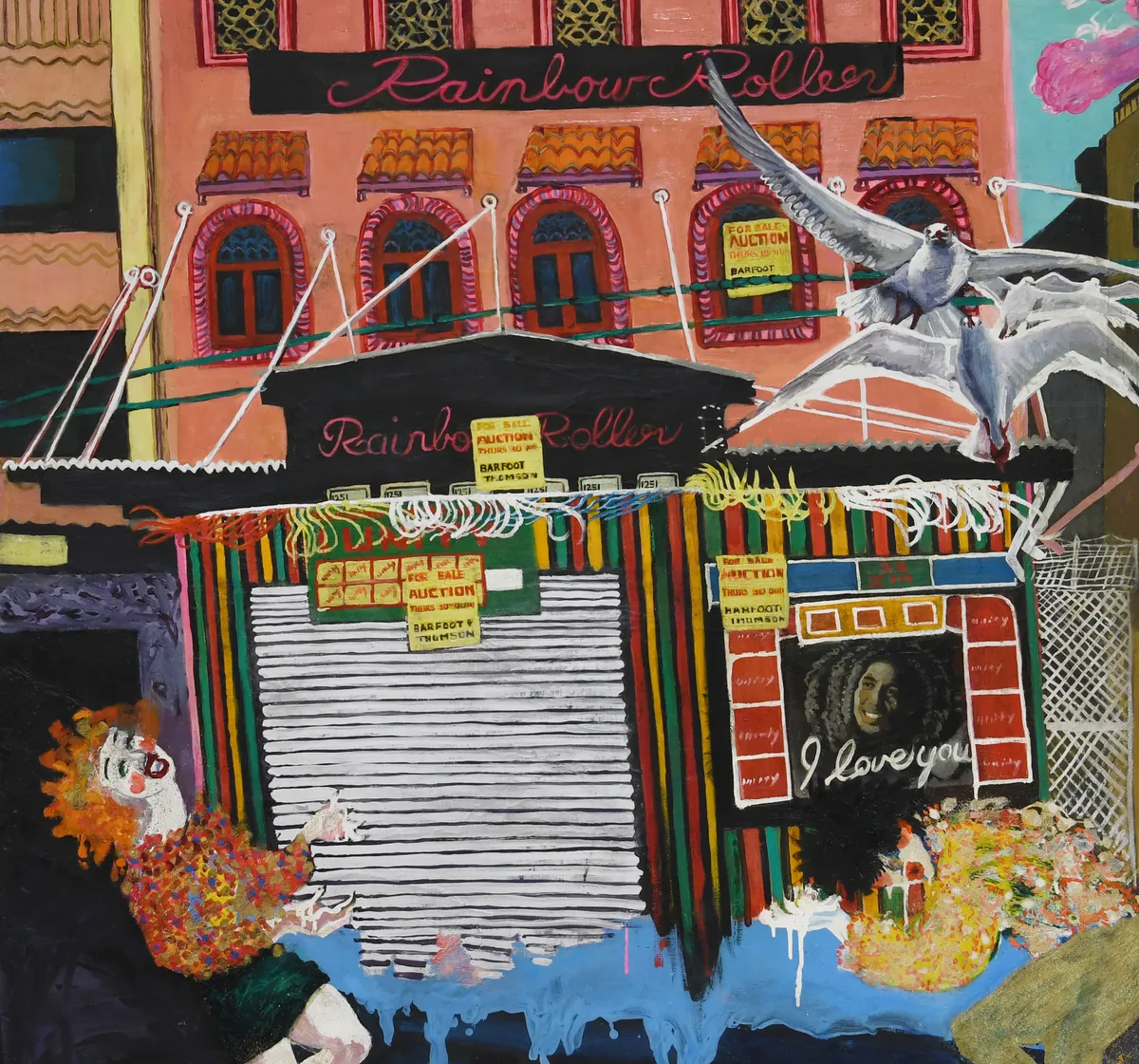
1700 x 1700mm framed
Recognisable for their riotous colour, exacting detail and an almost claustrophobic compression of perspective that can’t help but draw the viewer in, Fahey’s paintings are impossible to look away from.
Gow Langsford is proud to present a major exhibition surveying the work of Jacqueline Fahey from the 1950s to the present day. Protest Paintings brings together works spanning over seven decades of one of Aotearoa New Zealand’s most distinctive and celebrated artistic voices – whose unflinching eye for the sociopolitical world has only grown more piercing with time.
Now in her late nineties, Fahey is one of few female career artists of her generation to have sustained such fierce relevance – her gaze unwavering, her convictions uncompromised. As Director Anna Jackson notes in the accompanying exhibition catalogue; “It is a privilege, in the course of a career, to work closely with an artist whose life and practice have made a lasting contribution to the cultural life of this country. For me, that artist is Jacqueline Fahey.”
-
 Jacqueline Fahey, Juxtaposition, 2025
 -
Jacqueline Fahey, The Oldest Profession, 2017-19
-
Jacqueline Fahey, I Tell You I Saw it Myself!, 2016
-
Jacqueline Fahey, In My Studio, 2021
-
Jacqueline Fahey, The Passion Flower, 2009
-
Jacqueline Fahey, That is life, 2009
-
Jacqueline Fahey, Encounter with the Past, 2008
-
Jacqueline Fahey, Tragedy outside the dairy II, 2003
-
Jacqueline Fahey, Down in Grey Lynn Park, 2001
-
Jacqueline Fahey, K Rd, 1998
-
Jacqueline Fahey, Why are you doing this?, 1998
-
Jacqueline Fahey, Whatever Happened to Bernadette Devlin? [triptych], 1998
-
Jacqueline Fahey, Untitled, 1993
-
Jacqueline Fahey, Grandma and Emily, 1992
-
Jacqueline Fahey, Augusta and Lucy taking up the theatre, 1981-82
-
Jacqueline Fahey, Luncheon on the Grass, 1981-82
-
Jacqueline Fahey, The car as the erotic machine in the domain, or sacred and profane love, 1981-82
-
Jacqueline Fahey, Portrait of the Poet, 1978
-
Jacqueline Fahey, Last Summer, 1971
-
Jacqueline Fahey, The Tennis Player, 1971
-
Jacqueline Fahey, Cancer Ward, 1957


![Jacqueline Fahey, Whatever Happened to Bernadette Devlin? [triptych], 1998](https://static-assets.artlogic.net/w_600,c_limit,f_auto,fl_lossy,q_auto/artlogicstorage/gowlangsford/images/view/90b86cae34d043583afc47fd035ed19aj/gowlangsford-jacqueline-fahey-whatever-happened-to-bernadette-devlin-triptych-1998.jpg)


Gow Langsford is proud to present a major exhibition surveying the work of Jacqueline Fahey from the 1950s to the present day. Protest Paintings brings together works spanning over seven decades of one of Aotearoa New Zealand's most distinctive and celebrated artistic voices - whose unflinching eye for the sociopolitical world has only grown more piercing with time.
Now in her late nineties, Fahey is one of few female career artists of her generation to have sustained such fierce relevance - her gaze unwavering, her convictions uncompromised. As Director Anna Jackson notes in the accompanying exhibition catalogue; "It is a privilege, in the course of a career, to work closely with an artist whose life and practice have made a lasting contribution to the cultural life of this country. For me, that artist is Jacqueline Fahey."
Renowned for her depictions of suburban domestic life and the emotional complexities of motherhood, Fahey's practice has also consistently engaged with wider social and political realities. Across decades, she has remained devoted to truth-telling through paint, approaching even the most intimate subjects as acts of resistance and critique. Refusing sentimentality in favour of candour, intellect and emotional precision, Fahey has herself explained: "all my paintings are protest paintings."
Her paintings crackle with noise and presence - figures caught mid-sentence, mouths open, eyes ablaze, the clatter of crockery, the clink of gin bottles, conversations that press against the walls and burst through open windows into gardens, out into the street, into the outside world. Later works carry this electric charge into urban environments, where the tensions of private life erupt into public space. Recognisable for their riotous colour, exacting detail and an almost claustrophobic compression of perspective that can't help but draw the viewer in, Fahey's paintings are impossible to look away from.
The exhibition features significant works on loan from both public and private collections, as well as a recent painting completed last year. Each painting reaffirms her command of the medium, together bearing witness to a practice of ferocious vitality and unwavering courage. As Jackson observes: "This exhibition is not only a presentation of remarkable paintings; it is a testament to endurance, integrity and the uncompromising pursuit of truth through painting. Time has not softened Jacqueline's vision; it has sharpened our ability to see it."
Text by Anastasia Falkov
